
Population roughly doubled between 1950 and 1960
Pavers in Minnetonka, MN
Many Minnetonka homes have original concrete walks, stoops and slabs that have seen decades of frost. We replace them with pavers, or reset the pavers you already have.
- Free on-site estimates
- Written, itemized quotes with base depth listed
- Base built in compacted lifts, not dumped and leveled
Updating Hardscape on Established Lots
Much of the call for pavers in Minnetonka comes from homes that already have a walk, a patio or a driveway, just not a good one. The city went from 11,896 residents in 1950 to 25,037 in 1960 and 35,776 by 1970, according to census counts. Houses built in that stretch often still have their first concrete front walk and back slab. After that many Minnesota winters, those slabs tend to crack, tilt toward the house or settle where downspouts empty, and pavers are a common replacement because individual units can be lifted and reset later.
Tearing out, not covering up
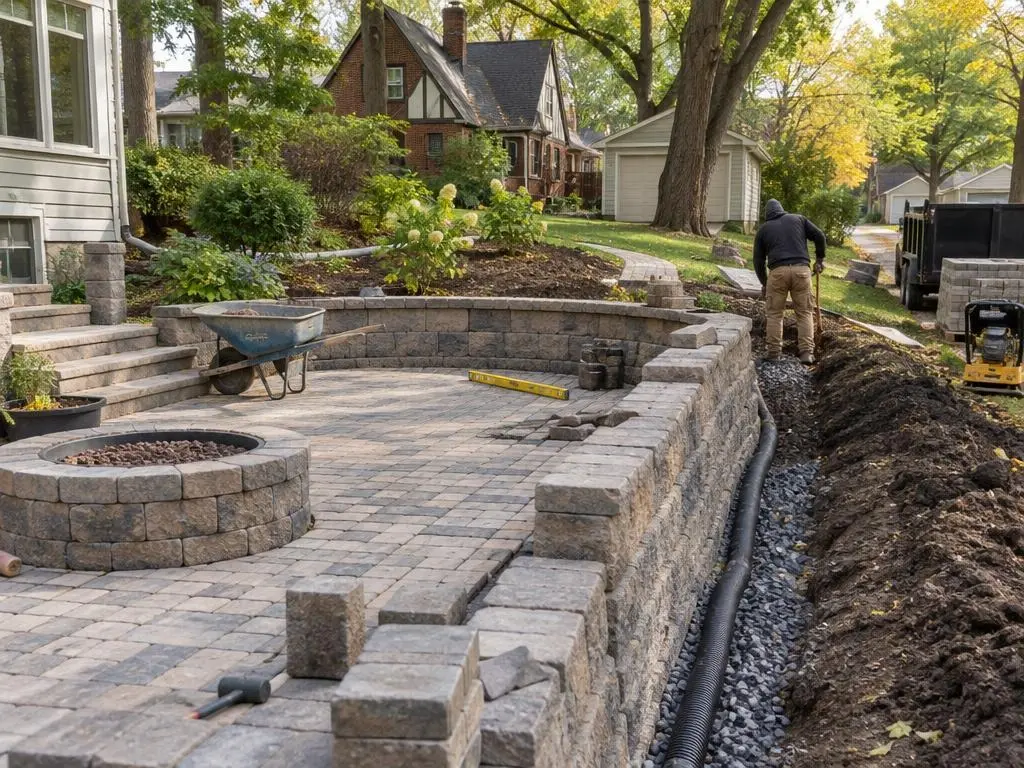
We do not lay pavers on top of failing concrete. The old slab comes out, and we dig to the depth the new surface needs. Unilock's base guidance calls for 4 to 6 inches of compacted base under pedestrian walkways and 8 to 12 inches under driveways, and for that base to extend past the paved edge by the same distance as its depth. Older slabs were sometimes poured on little or no gravel, which is part of why they move; we check what is under yours when it comes out.
Front steps and stoops
A cracked front stoop is a familiar problem on mid-century houses. Depending on the layout, we can rebuild the approach with paver treads and wall-block risers, or extend a landing so the step-up is easier. Step heights should be even from top to bottom; uneven risers are a trip hazard, especially when snow covers the edges. Where the stoop is attached to the foundation, we look at that connection before quoting.
Releveling pavers that already exist
Not every job is a rebuild. Paver patios and walks put in years ago can develop low spots, rocking units or edges that have drifted outward. When the base underneath is sound, we lift the affected area, add and compact bedding, reset the pavers, and refill the joints with fresh sand. If the base itself was too thin or never compacted, we will tell you, and quote the section as a rebuild instead of a patch that will sink again.
What we build here
- Replacement front walks and entry landings
- Back patios sized to replace an old slab or a rotting deck
- Driveway rebuilds on a vehicle-rated base
- Garden walls and low retaining walls along grade changes
- Fire pit areas with seating walls
- Relevel and reset work on existing paver areas
Trees and roots
Large shade trees and old foundations are part of what makes an established yard pleasant, and part of what pushes hardscape around. Before digging near a big tree we look at where the roots run and route walks around them rather than cutting large roots, which can harm the tree. Pavers are forgiving here: if a root lifts a section years from now, that section can be reset without demolishing the rest.
Planning the visit
Call (952) 800-9409 to book a walk-through. We will look at what you have now, note which parts can stay, and leave you with a written quote that separates removal, base work and new paving so you can see where the effort goes.
Minnetonka Housing and History
- A 1950s and 1960s growth wave. Census counts show Minnetonka at 6,466 people in 1940, 11,896 in 1950, 25,037 in 1960 and 35,776 in 1970, so a large share of homes date from the postwar decades and may still carry original concrete flatwork.
- Steady, not booming, housing growth since. Housing units rose from 22,228 in 2000 to 23,294 in 2010 and 25,080 in 2020. Most hardscape work in the city is replacement and upgrading on existing lots rather than first-time yards.
- First settlement west of Minneapolis. Minnetonka Mills was the first permanent European-American settlement west of Minneapolis in Hennepin County. The 1906 Minnetonka Town Hall and the Victorian Charles H. Burwell House are both on the National Register of Historic Places.
- Once heavily wooded. Before farming took over, the area was heavily wooded with maple, oak, elm, red cedar and basswood. Mature trees on many lots today mean root zones are worth mapping before any excavation.
Our Services in Minnetonka, MN
Minnetonka Questions
Can you put pavers over my old concrete patio to save the tear-out?
We don't recommend it. Overlaying raises the surface, can trap water and inherits every crack and tilt in the slab below. Removing the concrete and building a proper compacted base is what lets the new surface ride out frost.
My paver walk is only partly sunken. Do I need a whole new walk?
Often not. If the base is sound, we lift just the low area, rebuild the bedding and reset the same pavers. If several sections have failed, it usually points to a thin base, and a partial rebuild may be the better long-term choice.
Will digging for a new walkway hurt my big oak?
Cutting large roots can damage a tree, so we plan the path around the root zone where we can. Sometimes a gentle curve or a slightly raised section avoids the problem. We'll point out any conflict during the estimate.
When is the best time to book a project in Minnetonka?
Base work needs ground that is not frozen. The Twin Cities' last spring freeze typically comes around the start of May, and spring and early summer calendars fill quickly, so calling in late winter for an estimate helps you get a spot.
Free Estimates in Minnetonka, MN
Replacement and repair estimates for Minnetonka properties.
Pavers Near Minnetonka
- Pavers in Minneapolis, MN
- Pavers in Saint Paul, MN
- Pavers in Edina, MN
- Pavers in Bloomington, MN
- Pavers in Plymouth, MN
- Pavers in Maple Grove, MN
- Pavers in Eden Prairie, MN
- Pavers in Blaine, MN
- Pavers in Coon Rapids, MN
- Pavers in Lakeville, MN
- Pavers in Apple Valley, MN
- Pavers in Eagan, MN
- Pavers in Woodbury, MN
- Pavers in Prior Lake, MN
- Pavers in Chanhassen, MN
- Pavers in Shakopee, MN
- Pavers in Andover, MN