Rolling ground with 100-foot elevation swings
Pavers in Apple Valley, MN
Retaining walls, terraced patios and paver steps that turn a sloped Apple Valley yard into level, usable space.
- Free on-site estimates
- Written, itemized quotes with base depth listed
- Base built in compacted lifts, not dumped and leveled
Leveling Out a Sloped Apple Valley Yard
Apple Valley's terrain is rolling, with elevation differences of 100 feet or more between its lowest and highest points, and that shows up in backyards. Installing pavers in Apple Valley often starts with a retaining wall: a yard that drops off behind the house, a side yard too steep to mow safely, or a walk-out that leaves the patio door well above the lawn. Pavers and wall block together let us carve that slope into flat terraces you can use.
How a segmental wall holds a hill
Modern retaining walls are built from interlocking concrete block stacked on a compacted gravel leveling pad. The first course is partly buried, each course steps back slightly, and the space behind the block is filled with clean drainage stone with a perforated pipe at the base so water can escape. Without that drainage, water builds up behind the wall in spring and pushes it out of line. Taller walls may need reinforcement grid tied back into the soil and an engineered design, and many cities require a permit above a set height, so we check the requirements for your wall before construction.
Terraces instead of one big slope
Two shorter walls with a planting bed between them are often easier to build, look softer and put less load on each wall than one tall wall. A terraced layout can give you an upper patio off the house, a lower lawn level and wide paver steps connecting them. We plan step heights so each riser is the same, which matters for safety when steps are wet or snowy.
Patios on a slope
Even on a terrace, the paver surface needs a slight fall. Unilock's guidance calls a 1% to 2% slope adequate for drainage, and we point that fall away from the house and away from the top of any wall, so water isn't sent down behind the block. Base depth follows use: 4 to 6 inches of compacted base for walks and patios and 8 to 12 inches where vehicles drive.
Services we offer in Apple Valley
- Retaining walls and terraced landscape walls
- Paver patios on new level areas behind walls
- Paver steps and walkways linking yard levels
- Fire pits and seating walls, often built into a terrace
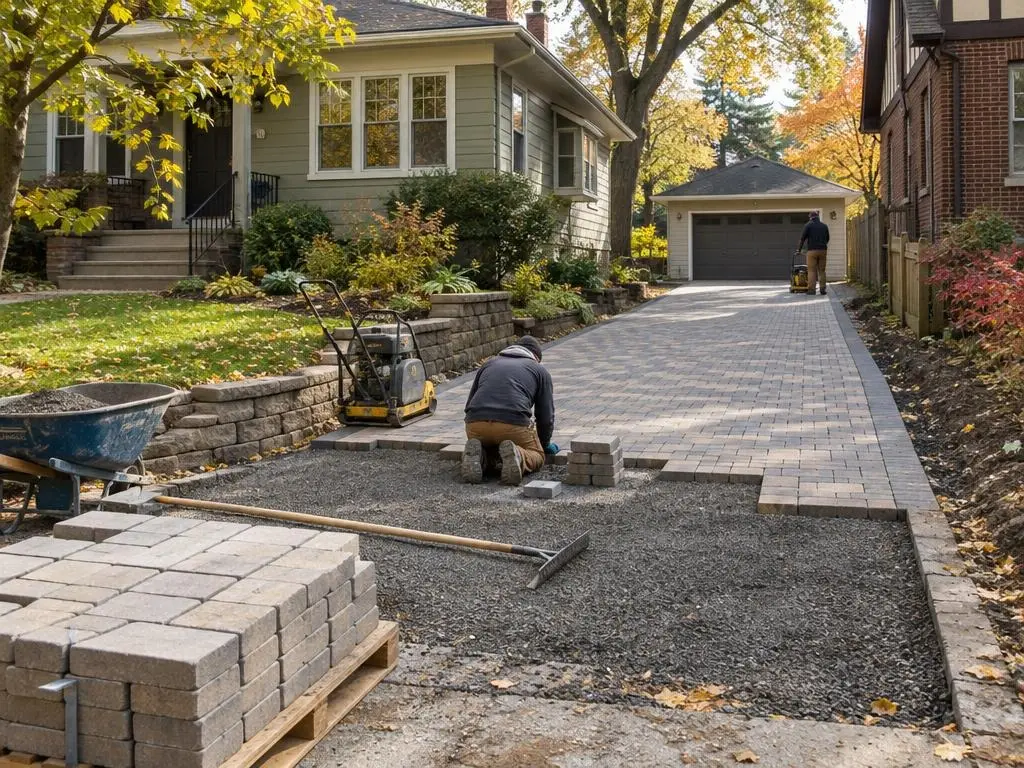
- Paver driveways on sloped approaches
- Repair and releveling, including resetting shifted wall caps
Where the runoff ends up
Many ponds and small lakes in the city do double duty as part of the stormwater system. The Minnesota DNR notes that Farquar Lake, at Pilot Knob Road and Diamond Path, serves primarily as a stormwater pond, and its water quality is poor with common algae blooms. Runoff carries soil and lawn debris into ponds like it. When we build on a slope, we keep exposed soil covered or contained during construction and direct finished drainage into turf and planting beds where possible.
Schedule a walk-through
Call (952) 800-9409 to set up a visit. We'll look at the grade, talk through wall heights and terrace options, and provide a written quote that lists wall block, drainage materials, base depth and paving for each level.
Apple Valley Terrain and Homes
- Rolling terrain. Apple Valley's terrain is rolling, with elevation differences of 100 feet or more between the lowest and highest points in the city. Sloped lots are common, which is why retaining walls and terraces come up so often.
- A planned 1960s and 70s suburb. Developer Orrin Thompson led the city's early development. Voters approved incorporation in 1968, and the population rose from 585 in 1960 to 8,502 in 1970 and 21,818 in 1980.
- Ponds that manage stormwater. The Minnesota DNR says Farquar Lake, at Pilot Knob Road and Diamond Path, serves primarily as a stormwater pond for the city. Its water quality is poor and algae blooms are common, so limiting sediment runoff matters.
- Ownership and home values. Census ACS estimates for 2020 to 2024 put Apple Valley's owner-occupied housing rate at 73.4% and the median owner-occupied value at $370,400. The city had 22,253 housing units in 2020.
Our Services in Apple Valley, MN
Apple Valley Questions
How tall can a retaining wall be before it needs a permit?
That depends on the city's current code and on what the wall is holding back, such as a driveway or structure above it. Taller walls generally need a permit and an engineered design. We check the requirement for your specific wall during planning and won't build a wall that needs plans without them.
Why are there gaps of gravel behind retaining walls?
That stone is the drainage zone. It lets water drain down to a pipe at the base instead of pushing against the block. It's one of the most important parts of a wall that lasts through freeze-thaw seasons.
Is one tall wall or two short walls better for my yard?
Often two. Terraced walls carry less load each, give you a planting bed in between and can be easier to build. The right answer depends on how much space you have from top to bottom. We'll sketch both if your lot allows it.
My wall caps are loose and a few blocks have leaned. Can that be fixed?
Loose caps can be re-glued with exterior block adhesive. A leaning section usually means a drainage or base problem, and the fix is to take that section down, correct the base and drainage, and rebuild it. We'll assess it on site.
Free Estimates in Apple Valley, MN
Written estimates for Apple Valley walls, terraces and patios.
Pavers Near Apple Valley
- Pavers in Minneapolis, MN
- Pavers in Saint Paul, MN
- Pavers in Edina, MN
- Pavers in Bloomington, MN
- Pavers in Plymouth, MN
- Pavers in Maple Grove, MN
- Pavers in Eden Prairie, MN
- Pavers in Minnetonka, MN
- Pavers in Blaine, MN
- Pavers in Coon Rapids, MN
- Pavers in Lakeville, MN
- Pavers in Eagan, MN
- Pavers in Woodbury, MN
- Pavers in Prior Lake, MN
- Pavers in Chanhassen, MN
- Pavers in Shakopee, MN
- Pavers in Andover, MN